
Executive Summary
Mineral scaling is one of the primary causes of reduced permeate flux and premature membrane performance deterioration in Reverse Osmosis (RO) and Nanofiltration (NF) plants.
Water sources containing elevated concentrations of calcium, sulfate, carbonate, fluoride, silica, and dissolved metals can contribute to mineral scaling and membrane fouling if left untreated.
AWC A-102 antiscalant is a broad-spectrum liquid scale inhibitor developed by American Water Chemicals (AWC) for industrial membrane systems.
Designed to control a wide range of inorganic scales, AWC A-102 antiscalant helps municipal utilities and industrial process facilities across Sub-Saharan Africa manage scale formation and maintain membrane performance.
The product inhibits calcium carbonate, calcium sulfate, calcium fluoride, barium sulfate, strontium sulfate, and silica scale formation. It also stabilizes metal ions, helps prevent metal oxide precipitation, and disperses existing metal oxides, hydroxides, silt, and clay particles.
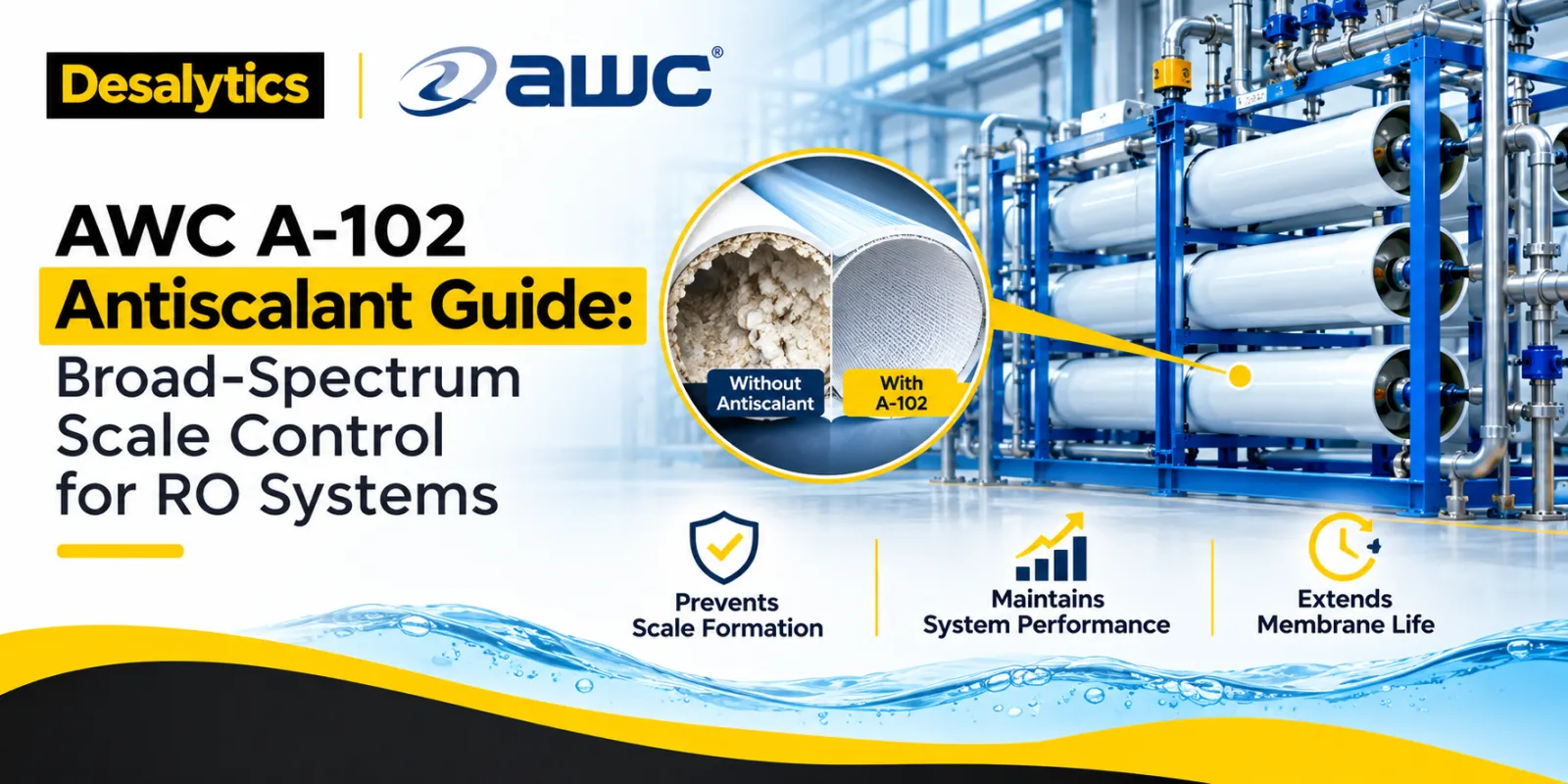
AWC A-102 antiscalant is a high-performance, broad-spectrum liquid scale inhibitor engineered by American Water Chemicals (AWC). Designed to control a wide range of inorganic scales, AWC A-102 antiscalant allows municipal utilities and industrial process facilities across Sub-Saharan Africa to operate at high recovery rates while protecting thin-film composite (TFC) membranes.
1. Core Technical Features of AWC A-102 Antiscalant
AWC A-102 antiscalant works by inhibiting inorganic scale formation, stabilizing metal ions, and dispersing suspended particles before they accumulate on membrane surfaces.
Calcium Carbonate Scale Control
Chemical name: Calcium carbonate
Chemical formula: CaCO₃
Calcium carbonate is a common mineral scale found in RO systems treating hard water.
AWC A-102 antiscalant inhibits calcium carbonate crystal formation and helps prevent scale accumulation on membrane surfaces.
The manufacturer’s published calcium carbonate inhibition limit depends on the product variant:
- AWC A-102 Ultra: CCNI up to 2.35.
- AWC A-102 Plus: CCNI up to 2.2.
The appropriate product should be selected based on feedwater chemistry and system operating conditions.
Sulfate Scale Inhibition
AWC A-102 antiscalant helps inhibit the formation of several sulfate-based mineral scales, including:
- Calcium sulfate (CaSO₄): A mineral scale that can form when calcium and sulfate concentrations become excessive.
- Barium sulfate (BaSO₄): A highly insoluble sulfate scale that can accumulate in membrane systems.
- Strontium sulfate (SrSO₄): An inorganic sulfate scale that may form in water containing elevated strontium and sulfate concentrations.
These compounds can contribute to membrane fouling and reduced system performance.
Calcium Fluoride Scale Inhibition
Chemical name: Calcium fluoride
Chemical formula: CaF₂
Calcium fluoride is an inorganic mineral scale that may form in RO systems treating water containing elevated calcium and fluoride concentrations.
AWC A-102 antiscalant helps inhibit calcium fluoride scale formation under suitable operating conditions.
Metal Oxide and Hydroxide Dispersal
AWC A-102 antiscalant helps stabilize metal ions to prevent metal oxide precipitation.
It also disperses existing metal oxides and hydroxides, as well as silt and clay particles.
Relevant chemical compounds include:
- Iron(III) oxide (Fe₂O₃): An iron oxide that may contribute to particulate fouling.
- Iron(III) hydroxide (Fe(OH)₃): An iron hydroxide that may form under suitable water chemistry conditions.
- Manganese oxides (MnOₓ): A general group of manganese oxide compounds.
- Manganese hydroxides (Mn(OH)ₓ): A general group of manganese hydroxide compounds.
The formulas MnOₓ and Mn(OH)ₓ represent general compositions rather than specific manganese compounds.
Silica and Colloidal Dispersal
Chemical name: Silicon dioxide
Chemical formula: SiO₂
Silica can contribute to membrane scaling when its concentration exceeds the limits permitted by the system’s operating conditions.
AWC A-102 antiscalant helps inhibit silica scale formation.
It also disperses colloidal particles, including silt, clay, and existing metal oxides and hydroxides.
Dissolved silica and colloidal silica should be distinguished because they represent different forms of silica in water.
Regulatory and Manufacturer Approvals
According to the manufacturer, AWC A-102 Ultra and AWC A-102 Plus:
- Are certified under NSF/ANSI Standard 60.
- Are compatible with polyamide membranes from major membrane manufacturers.
- Help inhibit inorganic scale formation in membrane separation processes.
Confirm the current certification and product variant before publishing regulatory or potable-water treatment claims.
2. Technical Specifications and Operating Parameters
The following specifications refer to AWC A-102 Ultra. AWC A-102 Plus is a separate product variant, and its specifications should be checked independently.
| Parameter | Specification |
|---|---|
| Appearance | Clear, colorless to yellow liquid |
| pH (as supplied, at 25°C) | 3–4 |
| Specific gravity | 1.10 ± 0.05 |
| Solubility in water | Completely soluble |
| Typical dosage | 1–5 ppm, depending on feedwater quality and operating conditions |
| Feeding point | Continuous injection into RO feedwater downstream of multimedia filtration |
| Preferred injection point | Downstream of cartridge filtration where a static mixer is available |
Recommended Dosing Procedure
AWC A-102 antiscalant should be injected continuously into the RO feedwater line.
The preferred injection point is downstream of multimedia filtration and, where possible, downstream of cartridge filtration with a static mixer.
Where a static mixer is unavailable, injection upstream of the cartridge filters can be used to improve mixing.
Typical Dosage
The typical dosage range is:
1–5 ppm
The exact dosage depends on:
- Feedwater composition
- Calcium concentration
- Sulfate concentration
- Fluoride concentration
- Silica concentration
- Barium and strontium concentrations
- Feedwater pH and temperature
- RO recovery
- System operating conditions
The dosage should be determined using Proton® membrane antiscalant projection software or through consultation with an AWC technical representative.
Chemical Dilution
AWC A-102 Ultra is designed to be fed neat.
If the minimum output of the dosing pump exceeds the required chemical dosage, dilution may be necessary.
For dilution:
- Use water free of detectable hardness.
- RO permeate or deionized water is preferred.
- Softened water is also acceptable.
- Avoid untreated hard water that may introduce scale-forming ions.
The product contains a preservative to prevent biological growth in the feed tank.
Dilution exceeding 10X can affect preservative effectiveness. If dilution beyond 10X is unavoidable, the manufacturer recommends replacing the diluted product frequently, preferably every 7–10 days.
3. Sector Applications Across Regional Markets
Municipal Drinking Water
Markets: Ghana, Nigeria, Kenya
Municipal utilities treating groundwater and other water sources may encounter elevated concentrations of calcium, sulfate, silica, and other scale-forming constituents.
AWC A-102 antiscalant helps inhibit inorganic scale formation in municipal RO plants, supporting membrane performance and operational efficiency.
Industrial Process Water and Agriculture
Markets: Tanzania, Uganda, Cameroon
Manufacturing facilities, commercial farms, and industrial water treatment plants may use RO systems to produce process water.
AWC A-102 antiscalant helps control mineral scale formation in suitable membrane applications.
For boiler feedwater and cooling systems, the chemical treatment program should be selected according to the specific treatment process and water chemistry.
4. Frequently Asked Questions (FAQs)
1. How is AWC A-102 antiscalant dosed into an RO system?
AWC A-102 antiscalant should be injected continuously into the RO feedwater line.
The preferred injection point is downstream of multimedia filtration and, where possible, downstream of cartridge filtration with a static mixer.
The product is designed to be fed neat, although dilution may be necessary when the dosing pump cannot operate at the required low feed rate.
2. Is AWC A-102 antiscalant safe for drinking water applications?
According to the manufacturer, AWC A-102 Ultra and AWC A-102 Plus are certified under NSF/ANSI Standard 60 for drinking water treatment applications.
The product must be used according to the applicable certification conditions, technical data sheet, and recommended dosage.
3. Which chemical scales can AWC A-102 antiscalant control?
AWC A-102 antiscalant helps inhibit:
- Calcium carbonate (CaCO₃)
- Calcium sulfate (CaSO₄)
- Calcium fluoride (CaF₂)
- Barium sulfate (BaSO₄)
- Strontium sulfate (SrSO₄)
- Silica (SiO₂)
It also stabilizes metal ions and disperses existing metal oxides, hydroxides, silt, and clay particles.
4. Can AWC A-102 antiscalant prevent iron fouling?
AWC A-102 helps stabilize metal ions to prevent metal oxide precipitation.
It also disperses existing metal oxides and hydroxides.
However, the effectiveness of metal control depends on feedwater chemistry and operating conditions.
For systems with significant iron or manganese contamination, additional pretreatment may be necessary.
5. Chemical Verification Summary
The following table uses standardized chemical names and formulas.
| Chemical name | Correct chemical formula |
|---|---|
| Calcium carbonate | CaCO₃ |
| Calcium sulfate | CaSO₄ |
| Calcium fluoride | CaF₂ |
| Barium sulfate | BaSO₄ |
| Strontium sulfate | SrSO₄ |
| Silicon dioxide (silica) | SiO₂ |
| Iron(III) oxide | Fe₂O₃ |
| Iron(III) hydroxide | Fe(OH)₃ |
| Manganese oxides | MnOₓ |
| Manganese hydroxides | Mn(OH)ₓ |
Chemical notation note: MnOₓ and Mn(OH)ₓ represent general manganese oxide and hydroxide compositions. They should not be presented as single, specific compounds unless the oxidation state and compound have been identified.
6. Protect Your RO System with AWC A-102 Antiscalant
Effective membrane protection begins with understanding feedwater chemistry and selecting the appropriate scale prevention strategy.
AWC A-102 antiscalant helps inhibit inorganic scale formation, stabilize metal ions, and disperse inorganic particles in reverse osmosis systems.
Desalytics supports industrial and municipal water treatment operators across Africa with membrane treatment solutions and technical guidance.
Contact Desalytics to discuss your RO system, feedwater analysis, and the appropriate AWC A-102 antiscalant dosage for your application.
Desalytics maintains localized stock hubs across Ghana, Nigeria, Cameroon, Kenya, Uganda, Tanzania, Zambia, Rwanda, and Ethiopia.
- Email: marketing@desalytics.com
- Service Coverage: Kenya, Uganda, Tanzania, Rwanda, Ethiopia, Zambia, Malawi, Zimbabwe Ghana, Nigeria, Cameroon, and East/West Africa.