
Executive Summary
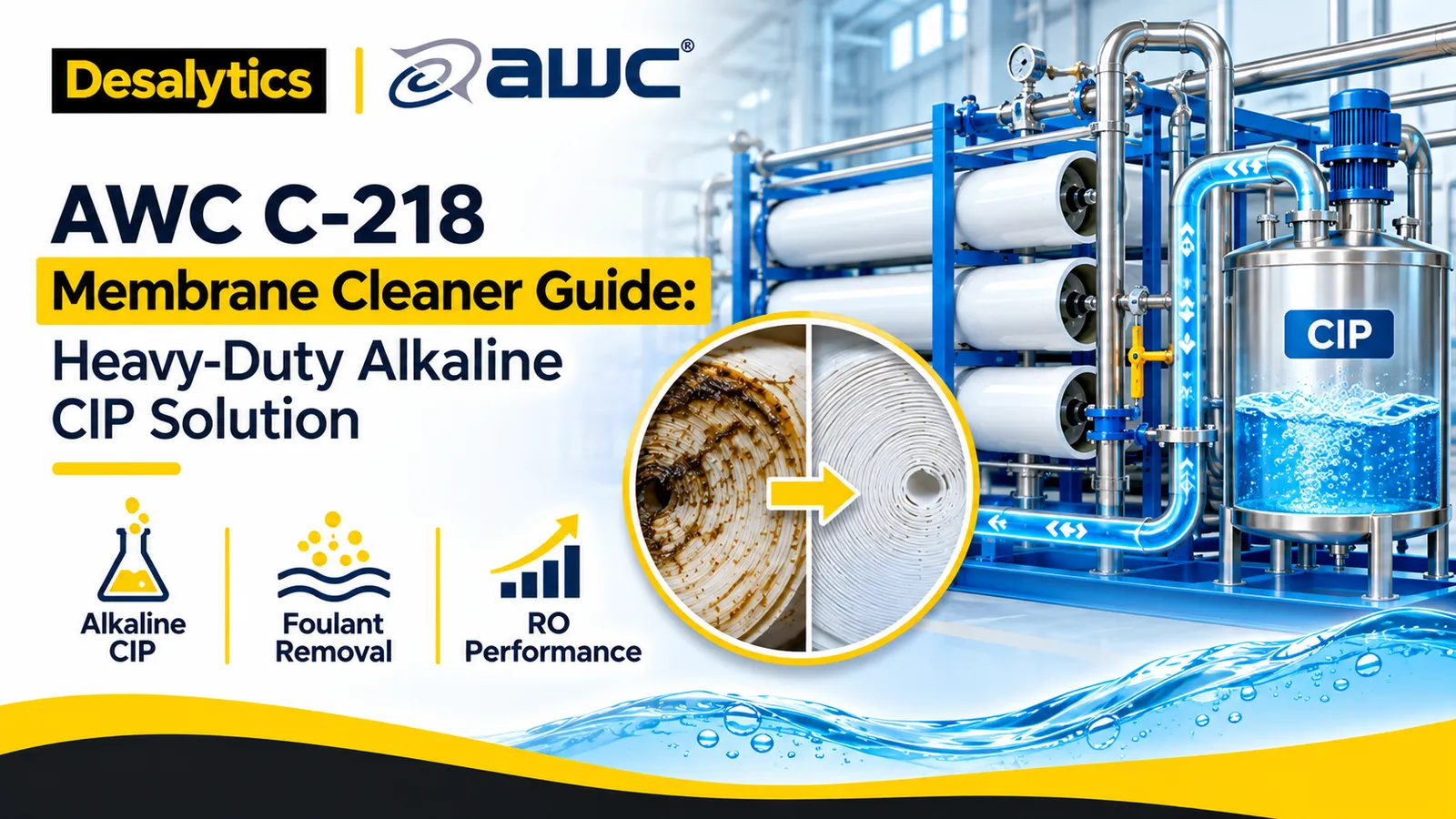
Over time, reverse osmosis (RO) membranes can accumulate biological foulants, biofilms, organic matter, and other deposits that reduce water production, increase differential pressure, and affect system performance.
When normalized permeate flow decreases, differential pressure increases, or salt passage rises beyond the membrane manufacturer’s recommended limits, a specialized Clean-In-Place (CIP) cleaning procedure may be required.
AWC C-218 membrane cleaner is a high-pH membrane cleaning chemical designed for the removal of biological fouling and biofilm from reverse osmosis membranes.
Distributed by Desalytics, AWC C-218 supports membrane maintenance by helping plant operators address biofouling and restore membrane performance in industrial water treatment applications.
For silica, silicate, and heavy organic fouling, other AWC cleaning products may be more appropriate depending on the type of deposit.
1. Operational Advantages of AWC C-218 Membrane Cleaner
Biofouling and Biological Deposit Removal
AWC C-218 is formulated for high-pH cleaning applications targeting biological fouling and biofilm accumulation on reverse osmosis membranes.
Its application helps address biological deposits that can restrict membrane flow, increase pressure drop, and reduce overall system efficiency.
High-pH Cleaning Application
AWC C-218 is used in high-pH membrane cleaning procedures.
High-pH cleaning is generally performed to penetrate and disperse biological and organic foulants. The cleaning solution must be prepared and operated according to the product’s technical data sheet and the membrane manufacturer’s cleaning limits.
Reverse Osmosis Membrane Maintenance
Proper CIP cleaning helps maintain membrane performance and can support longer membrane service life when performed according to the manufacturer’s recommendations.
AWC C-218 should only be used on membrane types and under operating conditions approved by the chemical supplier and membrane manufacturer.
Targeted Chemical Selection
Selecting the correct membrane cleaning chemical is essential for effective CIP performance.
AWC offers different cleaning products for specific fouling conditions:
- AWC C-218: Biofouling and biological deposits.
- AWC C-219: Silica fouling.
- AWC C-227: Heavy organic fouling.
- AWC C-236: Silica fouling.
- AWC C-237: Biofouling.
The appropriate chemical should be selected based on the type of foulant identified during membrane performance assessment.
2. Recommended CIP Protocol and Specifications
The following procedure provides general guidance for high-pH membrane cleaning. The exact concentration, temperature, pH, circulation flow, and cleaning duration must be confirmed using the current AWC C-218 technical data sheet and the membrane manufacturer’s recommendations.
| Parameter | Recommended operational guidance |
|---|---|
| Cleaning application | High-pH CIP for biofouling |
| Cleaning solution | Prepare using RO permeate or other manufacturer-approved water |
| Chemical concentration | Follow the current AWC C-218 technical data sheet |
| Cleaning pH | High-pH cleaning is generally performed around pH 11–12; confirm the product-specific target |
| Temperature | Maintain within the chemical supplier’s and membrane manufacturer’s maximum permitted temperature |
| Circulation | Follow recommended cleaning flow and pressure limits |
| Soaking | Apply according to the approved CIP procedure |
| Monitoring | Monitor pH, temperature, differential pressure, and cleaning solution condition |
General High-pH CIP Procedure
Step 1: Prepare the Cleaning Solution
Prepare the cleaning solution using the recommended chemical concentration and approved water quality.
Ensure that the cleaning tank and CIP system contain sufficient volume for the membrane system being cleaned.
Step 2: Initial Displacement
Displace the initial cleaning solution through the membrane system to drain according to the approved CIP procedure.
AWC’s general membrane cleaning guidance recommends directing the initial 20% of cleaning solution to drain before recirculation to help remove loose foulants and suspended solids.
Step 3: Recirculate the Cleaning Solution
Recirculate the remaining cleaning solution through the membrane system while monitoring pressure differential, pH, temperature, and cleaning flow.
Avoid exceeding the membrane manufacturer’s permitted cleaning pressure and flow limits.
Step 4: Allow the Membranes to Soak
Where permitted by the cleaning procedure, stop circulation and allow the cleaning solution to soak.
AWC’s general cleaning guidance describes alternating circulation and soaking periods of approximately 30–60 minutes. Confirm the appropriate duration for the specific membrane system and chemical.
Step 5: Monitor Cleaning Conditions
Monitor the cleaning solution throughout the CIP cycle.
Check pH periodically and maintain the recommended cleaning conditions.
If the cleaning solution becomes heavily discolored or turbid, evaluate whether it should be replaced.
Step 6: Flush the Membranes
After cleaning, flush the membrane system using RO permeate or other manufacturer-approved water until the cleaning solution has been adequately removed.
Return the system to service according to the membrane manufacturer’s startup procedure.
Important Chemical Selection Note
AWC C-218 is intended for biofouling applications.
For silica or silicate deposits, consider an appropriate silica-focused cleaning chemical such as AWC C-219 or C-236, subject to the supplier’s recommendations.
For heavy organic fouling, AWC C-227 may be an appropriate alternative.
Chemical selection should be based on foulant identification rather than assuming that one cleaner is suitable for every type of membrane deposit.
3. Target Sectors Across Africa
Food, Beverage and Bottled Water
Markets: Ghana, Nigeria, Cameroon
RO systems used in food and beverage production can experience biological fouling that affects water production and operating efficiency.
AWC C-218 can support membrane maintenance programs where biofouling has been identified as a cleaning requirement.
Municipal Utilities and Wastewater Reuse
Markets: Kenya, Uganda, Zambia
Municipal water treatment and wastewater reuse facilities may experience biological fouling in membrane systems.
Appropriate high-pH cleaning procedures can help address biological deposits and support membrane performance.
Industrial Water Treatment
Industrial facilities using RO systems for process water production may require periodic CIP cleaning to manage biological fouling.
Desalytics can support customers in identifying appropriate membrane cleaning chemicals and establishing suitable maintenance procedures.
4. Frequently Asked Questions
1. What is AWC C-218 membrane cleaner used for?
AWC C-218 is a high-pH membrane cleaning chemical used for biofouling and biological deposit removal in reverse osmosis systems.
It is intended for applications where biological fouling has been identified as a membrane cleaning requirement.
2. When should I clean membranes with AWC C-218 membrane cleaner?
Membrane cleaning should be considered when normalized permeate flow decreases, differential pressure increases, or salt passage rises beyond the membrane manufacturer’s recommended limits.
AWC’s general guidance identifies a 10% decrease in normalized permeate flow, a 15% increase in differential pressure, or a 10% increase in salt passage as potential cleaning indicators.
These are general indicators and should be evaluated against the specific membrane manufacturer’s operating criteria.
3. Can AWC C-218 remove silica and sulfate scale?
AWC C-218 is primarily intended for biofouling applications.
For silica and silicate fouling, AWC identifies products such as C-219 and C-236.
Calcium sulfate and barium sulfate deposits require appropriate foulant identification and supplier guidance before selecting a cleaning chemical.
Do not assume that AWC C-218 is suitable for removing all inorganic scales.
4. Can AWC C-218 membrane cleaner be reused for multiple CIP stages?
The reuse of cleaning solution depends on its condition, the cleaning procedure, and the chemical supplier’s recommendations.
AWC’s general cleaning guidance recommends monitoring pH and the condition of the cleaning solution.
If the solution becomes heavily discolored or turbid, it may need to be replaced.
Do not rely on a universal pH threshold for reuse without confirmation from the current product technical data sheet.
5. What is the recommended concentration for AWC C-218?
The correct cleaning concentration must be obtained from the current AWC C-218 technical data sheet.
The concentration should be selected according to the membrane system, fouling condition, and approved CIP procedure.
6. Is AWC C-218 compatible with all RO membranes?
Compatibility depends on the membrane material, chemical concentration, cleaning pH, temperature, and exposure duration.
Always confirm compatibility with the membrane manufacturer and AWC before applying the chemical.
5. Restore RO Membrane Performance with Desalytics
Maintaining reverse osmosis membrane performance requires the correct identification of foulants and selection of suitable cleaning chemicals.
AWC C-218 provides a high-pH cleaning option for biofouling applications, while other AWC products address specific silica and heavy organic fouling conditions.
Desalytics supports water treatment operators across Africa with membrane cleaning chemical solutions and technical guidance for industrial water treatment applications.
Contact Desalytics to discuss your RO membrane cleaning requirements and identify the appropriate AWC cleaning solution for your application.
Desalytics maintains localized stock hubs across Ghana, Nigeria, Cameroon, Kenya, Uganda, Tanzania, Zambia, Rwanda, and Ethiopia.
- Email: marketing@desalytics.com
- Service Coverage: Kenya, Uganda, Tanzania, Rwanda, Ethiopia, Zambia, Malawi, Zimbabwe Ghana, Nigeria, Cameroon, and East/West Africa.