
Executive Summary
Industrial water plant operators and municipal utilities require cost-effective, dependable scale prevention solutions to keep operational expenditure (OPEX) low without compromising membrane performance.
Pureflux M antiscalant is a broad-spectrum liquid antiscalant designed to inhibit inorganic scale formation in reverse osmosis (RO) and other membrane separation processes.
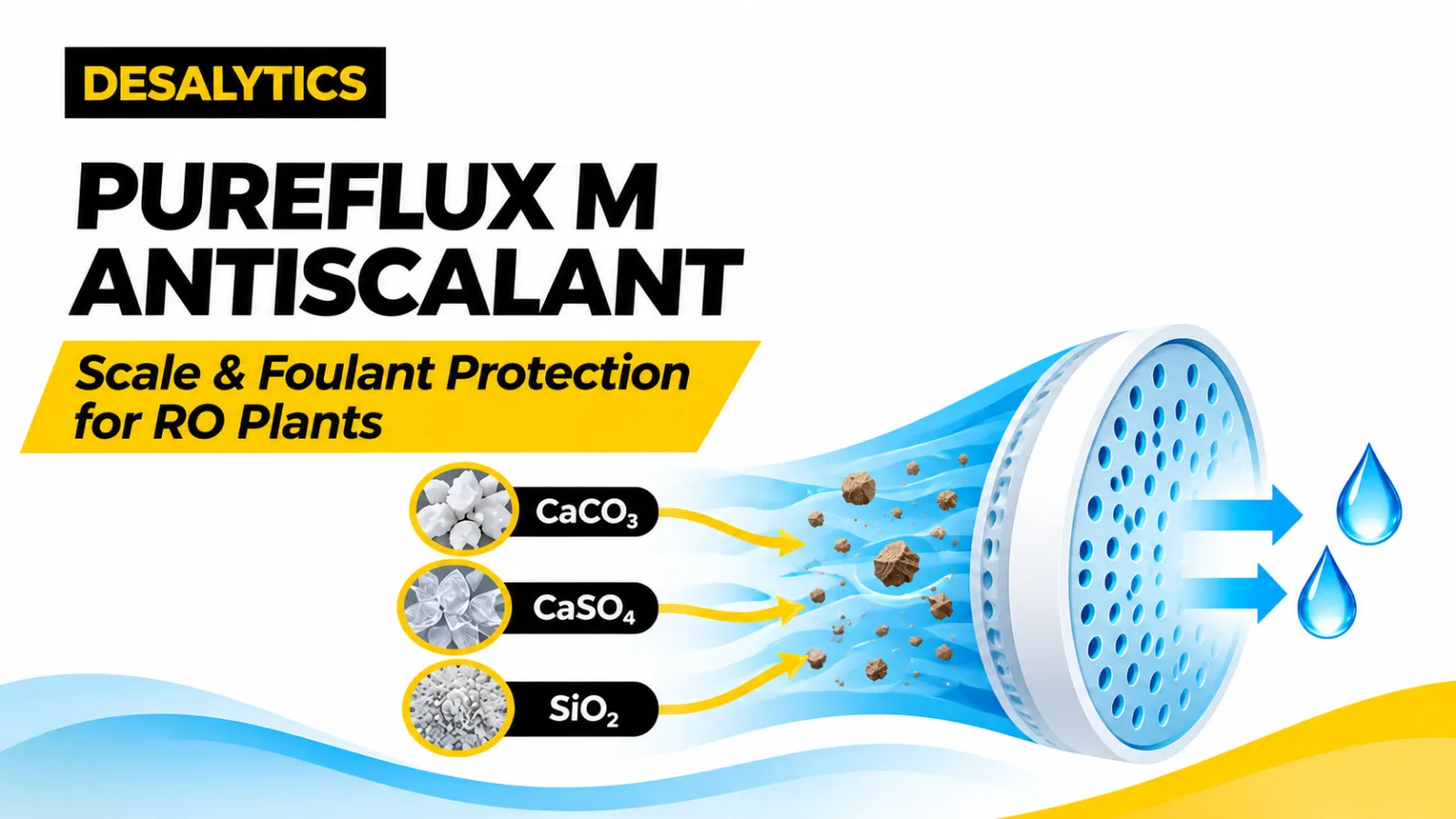
It helps inhibit calcium carbonate, calcium sulfate, calcium fluoride, barium sulfate, and strontium sulfate scale formation. Pureflux M also stabilizes metal ions, helps prevent metal oxide precipitation, disperses existing metal oxides and hydroxides, and assists in preventing silica scale formation.
Distributed by Desalytics across Kenya, Uganda, Zambia, Rwanda, Ethiopia, Ghana, Nigeria, Tanzania, and Cameroon, Pureflux M supports membrane protection and scale control across a variety of industrial water treatment applications.
1. Key Features of Pureflux M Antiscalant
Broad-Spectrum Scale Inhibition
Pureflux M helps inhibit the formation of several common inorganic scales in RO systems, including:
- Calcium carbonate (CaCO₃)
- Calcium sulfate (CaSO₄)
- Calcium fluoride (CaF₂)
- Barium sulfate (BaSO₄)
- Strontium sulfate (SrSO₄)
These mineral deposits can accumulate on membrane surfaces and reduce system performance.
Pureflux M helps control scale formation by interfering with the development of inorganic mineral deposits.
Metal Ion Stabilization and Dispersal
Pureflux M helps stabilize dissolved metal ions and prevent their precipitation as metal oxides.
It also disperses existing metal oxides and metal hydroxides, helping manage inorganic particulate fouling.
Relevant chemical compounds include:
- Iron(III) oxide (Fe₂O₃)
- Iron(III) hydroxide (Fe(OH)₃)
- Manganese oxides (MnOₓ)
- Manganese hydroxides, where present
Important: MnOₓ represents a general manganese oxide composition. The specific manganese oxide formed depends on the oxidation state and treatment conditions.
Silica Scale Prevention
Pureflux M helps prevent silica scale formation in membrane separation systems.
Silica is commonly represented as silicon dioxide (SiO₂), although dissolved silica in water is often present as silicic acid and other dissolved silica species.
Pureflux M helps control silica-related scaling under suitable operating conditions.
Membrane Compatibility and Certifications
According to the manufacturer, Pureflux M:
- Is approved for use by major membrane manufacturers.
- Is certified to NSF/ANSI Standard 60.
- Is Halal certified.
- Is Kosher certified.
Confirm the current product certification and applicable conditions before making regulatory or potable-water treatment claims.
2. Technical Profile & Dosing Instructions
| Parameter | Specification |
|---|---|
| Appearance | Clear, colorless liquid |
| Odor | Characteristic |
| Solubility | Completely soluble in water |
| Typical dosage | 1–5 ppm, depending on feedwater quality and system operating conditions |
| Dosing point | RO feedwater line, downstream of multimedia filtration and preferably downstream of cartridge filtration where a static mixer is available |
| Chemical feed | Designed for neat dosing |
| Dilution water | Water free of detectable hardness; RO permeate or deionized water preferred |
Recommended Dosing Procedure
Pureflux M should be injected continuously into the RO feedwater line.
The preferred injection point is downstream of multimedia filtration and, where possible, downstream of cartridge filtration with a static mixer to promote effective mixing.
Where a static mixer is unavailable, the manufacturer indicates that injection upstream of cartridge filtration can be used as an alternative.
Typical Dosage
The typical dosage range is:
1–5 ppm
The exact dosage depends on:
- Feedwater composition
- Calcium and other scale-forming ions
- Feedwater pH
- Temperature
- RO recovery
- Membrane operating conditions
- Potential scale formation in the concentrate stream
The dosage should be determined using appropriate membrane projection software or through consultation with an AWC technical representative.
Chemical Dilution
Pureflux M is designed to be fed neat.
If the minimum output of the dosing pump exceeds the required chemical dosage, dilution may be necessary.
For dilution:
- Use water free of detectable hardness.
- RO permeate or deionized water is preferred.
- Softened water is also acceptable according to the manufacturer.
- Avoid untreated hard water that may introduce scale-forming ions.
The product contains a preservative to prevent biological growth in the feed tank.
Dilution exceeding 10X can affect preservative effectiveness. If dilution beyond 10X is unavoidable, the manufacturer recommends replacing the diluted product frequently, preferably every 7–10 days.
3. Deployment Across Regional Operating Markets
Commercial Building Services
Markets: Nigeria, Ghana, Cameroon
Commercial buildings, hotels, and industrial facilities may use RO systems for water purification and cooling tower makeup water treatment.
Pureflux M helps control inorganic scale formation in suitable RO applications, supporting membrane performance and operational efficiency.
Agricultural & Industrial Water
Markets: Kenya, Uganda, Tanzania, Rwanda
Agricultural and industrial operations often rely on RO systems to produce water for irrigation, agro-processing, and industrial applications.
Pureflux M helps inhibit mineral scale formation and supports membrane maintenance where feedwater chemistry presents a scaling risk.
Municipal and Industrial Water Treatment
Markets: Zambia, Ethiopia, and other regional markets
Municipal and industrial water treatment facilities may experience scaling caused by calcium, sulfate, fluoride, silica, and other inorganic constituents.
Pureflux M provides broad-spectrum scale inhibition to help protect membrane systems against these deposits.
4. Frequently Asked Questions (FAQs)
1. What is Pureflux M antiscalant used for?
Pureflux M is a broad-spectrum antiscalant designed to inhibit inorganic scale formation in reverse osmosis and other membrane separation processes.
It helps control calcium carbonate, calcium sulfate, calcium fluoride, barium sulfate, and strontium sulfate scale formation.
It also supports metal ion stabilization, particulate dispersal, and silica scale prevention.
2. How is Pureflux M antiscalant diluted if chemical pumps require lower dosing rates?
Pureflux M is designed to be fed neat.
If the dosing pump’s minimum output exceeds the required chemical feed rate, dilution may be necessary.
Use RO permeate, deionized water, or other manufacturer-approved water free of detectable hardness.
Avoid untreated hard water that may introduce calcium, magnesium, or other scale-forming ions.
Dilution beyond 10X can affect the product’s preservative effectiveness.
If dilution beyond 10X is unavoidable, the manufacturer recommends replacing the diluted product frequently, preferably every 7–10 days.
3. How do I determine the exact dosage of Pureflux M antiscalant?
The correct dosage depends on the complete feedwater analysis and the RO system’s operating conditions.
Important parameters include:
- Total dissolved solids (TDS)
- pH
- Temperature
- Calcium concentration
- Magnesium concentration
- Sulfate concentration
- Fluoride concentration
- Silica concentration
- Barium and strontium concentrations
- RO recovery and concentrate composition
Desalytics can help customers determine the appropriate dosage using membrane projection software and technical assessment.
The typical dosage is 1–5 ppm, but the actual requirement should be calculated for the specific system.
4. Can Pureflux M control iron and manganese fouling?
Pureflux M helps stabilize metal ions and prevent metal oxide precipitation.
It also disperses existing metal oxides and hydroxides, as well as silt and clay particles.
However, the effectiveness of metal control depends on the feedwater chemistry and operating conditions.
For systems with significant iron or manganese contamination, pretreatment and feedwater quality assessment may also be necessary.
5. Chemical Verification Summary
The following chemical names and formulas use standardized chemical notation.
| Chemical name | Correct chemical formula | Application |
|---|---|---|
| Silica / Silicon dioxide | SiO₂ | Silica scale prevention |
| Calcium carbonate | CaCO₃ | Mineral scale inhibition |
| Calcium sulfate | CaSO₄ | Sulfate scale inhibition |
| Barium sulfate | BaSO₄ | Sulfate scale inhibition |
| Strontium sulfate | SrSO₄ | Sulfate scale inhibition |
| Calcium fluoride | CaF₂ | Fluoride scale inhibition |
| Iron(III) oxide | Fe₂O₃ | Metal oxide dispersal |
| Iron(III) hydroxide | Fe(OH)₃ | Metal hydroxide dispersal |
| Manganese oxides | MnOₓ | Metal oxide dispersal |
| Manganese hydroxides | Mn(OH)ₓ | Metal hydroxide dispersal |
Chemical notation note: MnOₓ and Mn(OH)ₓ represent general manganese oxide and hydroxide compositions. They should not be presented as single, specific compounds unless the oxidation state and compound have been identified.
6. Protect Your RO System with Pureflux M
Effective membrane protection begins with understanding feedwater chemistry and selecting the appropriate scale prevention strategy.
Pureflux M helps inhibit inorganic scale formation, stabilize metal ions, disperse inorganic particles, and support silica scale prevention in reverse osmosis systems.
Desalytics supports industrial and municipal water treatment operators across Africa with membrane treatment solutions and technical guidance.
Contact Desalytics to discuss your RO system, feedwater analysis, and the appropriate Pureflux M antiscalant dosage for your application.
Desalytics maintains localized stock hubs across Ghana, Nigeria, Cameroon, Kenya, Uganda, Tanzania, Zambia, Rwanda, and Ethiopia.
- Email: marketing@desalytics.com
- Service Coverage: Kenya, Uganda, Tanzania, Rwanda, Ethiopia, Zambia, Malawi, Zimbabwe Ghana, Nigeria, Cameroon, and East/West Africa.